A microprocessor is a multipurpose, programmable, clock-driven, register-based electronic device that reads binary instructions from a storage device called memory, accepts binary data as input and processes data according to those instructions and provide results as output. A 8085 microprocessor, is a second generation 8-bit microprocessor and is the base for studying and using all the microprocessor available in the market. Registers in 8085: (a) General Purpose Registers – The 8085 has six general-purpose registers to store 8-bit data; these are identified as- B, C, D, E, H, and L. These can be combined as register pairs – BC, DE, and HL, to perform some 16-bit operation. These registers are used to store or copy temporary data, by using instructions, during the execution of the program. (b) Specific Purpose Registers –
(c) Memory Registers – There are two 16-bit registers used to hold memory addresses. The size of these registers is 16 bits because the memory addresses are 16 bits. They are :-
Fast access: Registers provide a fast and efficient way to access data and perform operations. Since the registers are located inside the processor, they can be accessed quickly without having to wait for data to be fetched from memory.
Programming Model 8085 8085 Microprocessor
Reduced memory access: The use of registers can help reduce the number of memory accesses required, which can improve the overall performance of the system.
Specialized functionality: Each register in the 8085 microprocessor has a specific function, such as the accumulator for arithmetic operations and the program counter for storing the address of the next instruction. This specialized functionality can make programming and debugging easier.
Limited storage capacity: The 8085 microprocessor has a limited number of registers, which can restrict the amount of data that can be stored and manipulated at any given time.
Pin Diagram And Pin Description Of 8085
Complex addressing modes: Some of the addressing modes used in the 8085 microprocessor can be complex, which can make programming more difficult.
Lack of flexibility: The fixed number and function of registers in the 8085 microprocessor can limit the flexibility of the system and make it more difficult to adapt to changing requirements.
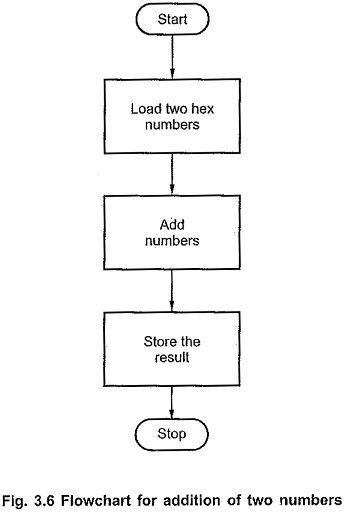
We use cookies to ensure you have the best browsing experience on our website. By using our site, you acknowledge that you have read and understood our Cookie Policy & Privacy PolicyLet us define a program statement as ‘Write and Executing Assembly Language Programming 8085 to add two numbers’. The three tasks are involved in this program :
Program To Print The Table Of Input Integer
These tasks for Write and Executing Assembly Language Programming 8085 can be symbolically presented as flow chart, as shown in the Fig. 3.6.
We want to execute three tasks in a sequence, thus writing corresponding instructions in the same sequence constitutes an Assembly Language Programming 8085.
Once the Assembly Language Programming 8085 is ready, it is necessary to convert it in the machine language program. It is possible to do this by referring the proper hex code for each, assembly instruction from the 8085 instruction set manual. This process is known as hand assembly and the resulted machine language program is also known as hex code. Let us see the hex code for our program.
Bus Organization Of 8085 Microprocessor
Once the hex code is ready, it has to be loaded in the memory of specially designed microprocessor system (Microprocessor training kit) for execution. To perform this task we should know the address range of read/write memory in the system.
Let us assume that the read/write memory ranges from 2000H to 22FFH. The microprocessor training kit has keypad to enter the hex code, in the memory. It provides a special routines (monitor program) to enter a hex code byte by byte and execute the program. Typical steps for storing hex code in the memory from address from address 2000H are as follows :

The microprocessor training kit provides a procedure to execute the program. To activate the procedure we have to enter the starting address of the program (2000H in our example). To enter this address we have to go into execute mode by pressing GO key and enter the starting address using hex keys.
Program To Access And Exchange The Content Of Flag Register With Register B
Once the starting address is entered, the program can be executed by pressing EXECUTE key. The EXECUTE key procedure loads the starting address of our program, 2000H into the program counter and program control is transferred from monitor program to our program.
After this microprocessor reads one hex code at a time, and when it fetches the complete instruction, it executes that instruction. Then it fetches the next instruction and this process continues until the last instruction in the program is executed.It is an 8-bit register used to perform arithmetic, logical, I/O & LOAD/STORE operations. It is connected to internal data bus & ALU.
There are 6 general purpose registers in 8085 processor, i.e. B, C, D, E, H & L. Each register can hold 8-bit data.
New 8085 Cpu Module Designed For Rc2014
It is a 16-bit register used to store the memory address location of the next instruction to be executed. Microprocessor increments the program whenever an instruction is being executed, so that the program counter points to the memory address of the next instruction that is going to be executed.
It is an 8-bit register having five 1-bit flip-flops, which holds either 0 or 1 depending upon the result stored in the accumulator.

It is an 8-bit register. When an instruction is fetched from memory then it is stored in the Instruction register. Instruction decoder decodes the information present in the Instruction register.
Doc) Questions Bank 8085
It provides timing and control signal to the microprocessor to perform operations. Following are the timing and control signals, which control external and internal circuits −
As the name suggests it controls the interrupts during a process. When a microprocessor is executing a main program and whenever an interrupt occurs, the microprocessor shifts the control from the main program to process the incoming request. After the request is completed, the control goes back to the main program.
The content stored in the stack pointer and program counter is loaded into the address buffer and address-data buffer to communicate with the CPU. The memory and I/O chips are connected to these buses; the CPU can exchange the desired data with the memory and I/O chips.
Main Difference Between 8085 And 8086 Microprocessor
Data bus carries the data to be stored. It is bidirectional, whereas address bus carries the location to where it should be stored and it is unidirectional. It is used to transfer the data & Address I/O devices.It is used to perform mathematical operations like addition, multiplication, subtraction, division, decrement, increment, etc. Different operations are carried out in ALU: Logical operations, Bit-Shifting Operations, and Arithmetic Operations.
It is an 8-bit register that stores either 0 or 1 depending upon which value is stored in the accumulator. Flag Register contains 8-bit out of which 5-bits are important and the rest of 3-bits are “don’t Care conditions”. The flag register is a dynamic register because after each operation to check whether the result is zero, positive or negative, whether there is any overflow occurred or not, or for comparison of two 8-bit numbers carry flag is checked. So for numerous operations to check the contents of the accumulator and from that contents if we want to check the behavior of given result then we can use Flag register to verify and check. So we can say that the flag register is a status register and it is used to check the status of the current operation which is being carried out by ALU.
Accumulator is used to perform I/O, arithmetic, and logical operations. It is connected to ALU and the internal data bus.The accumulator is the heart of the microprocessor because for all arithmetic operations Accumulator’s 8-bit pin will always there connected with ALU and in most-off times all the operations carried by different instructions will be stored in the accumulator after operation performance.
T States Of All Instructions Of 8085 Microprocessor Shivajees Mcq
There are six general-purpose registers. These registers can hold 8-bit values. These 8-bit registers are B, C, D, E, H, L. These registers work as 16-bit registers when they work in pairs like B-C, D-E, and H-L. Here registers W and Z are reserved registers. We can’t use these registers in arithmetic operations. It is reserved for microprocessors for internal operations like swapping two 16-bit numbers. We know that to swap two numbers we need a third variable hence here W-Z register pair works as temporary registers and we can swap two 16-bit numbers using this pair.
Program Counter holds the address value of the memory to the next instruction that is to be executed. It is a 16-bit register.
For Example: Suppose current value of Program Counter : [PC] = 4000H (It means that next executing instruction is at location 4000H.After fetching, program Counter(PC) always increments by +1 for fetching of next instruction.) Stack Pointer :
Assignment Microprocessor 8085
It works like a stack. In stack, the content of the register is stored that is later used in the program. It is a 16-bit special register. The stack pointer is part of memory but it is part of Stack operations, unlike random memory access. Stack pointer works in a continuous and contiguous part of the memory. whereas Program Counter(PC) works in random memory locations. This pointer is very useful in
0 komentar
Posting Komentar